Which Camera Should You Actually Buy? (An Honest Guide by Wedding Filmmakers)
“Your camera doesn’t make a wedding unforgettable. You do.”
Let’s start with a confession.
Every wedding photographer has done this.
It’s 1:30 in the morning.
You’ve just finished editing a wedding.
Instead of sleeping, you’re watching YouTube videos titled:
“Canon is DEAD!”
Five minutes later…
Another creator confidently says,
“Sony destroys everyone!”
Scroll a little more…
Now Nikon is apparently the king.
Then Lumix enters the chat.
Someone else swears by Fujifilm.
At this point, you’re more confused than the groom trying to remember which pocket holds the ring.
Sound familiar?
Trust me, you’re not alone.
At Sanjog Diaries, we’ve spent years shooting weddings across Dehradun, Mussoorie, Rishikesh, Haridwar, and the sacred Triyuginarayan Temple. We’ve worked in palaces, mountain resorts, temples, farms, luxury hotels, and tiny village homes where electricity disappeared halfway through the ceremony.
If there’s one thing weddings have taught us, it’s this:
The best wedding camera isn’t always the newest one.
It’s the one you can trust when life refuses to follow the script.
So… Which Brand Is Actually the Best?
Short answer?
There isn’t one.
I know that’s probably not the answer you wanted.
But hear me out.
Every major camera company today builds incredible cameras.
Canon.
Sony.
Nikon.
Panasonic Lumix.
Fujifilm.
Each one has strengths.
Each one has weaknesses.
The trick isn’t finding the “best” camera.
The trick is finding the best camera for the way you shoot weddings.
Let’s meet the contenders.
Sony: The Wedding Filmmaker’s Favorite
If wedding filmmakers had a fan club, Sony would probably be the president.
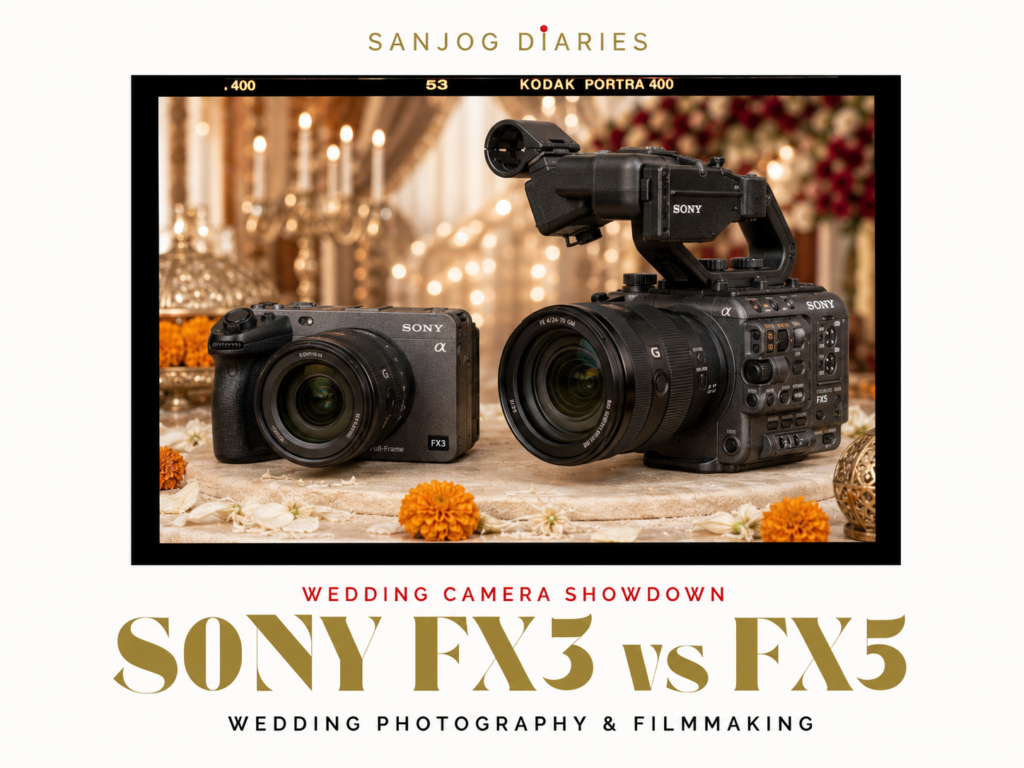
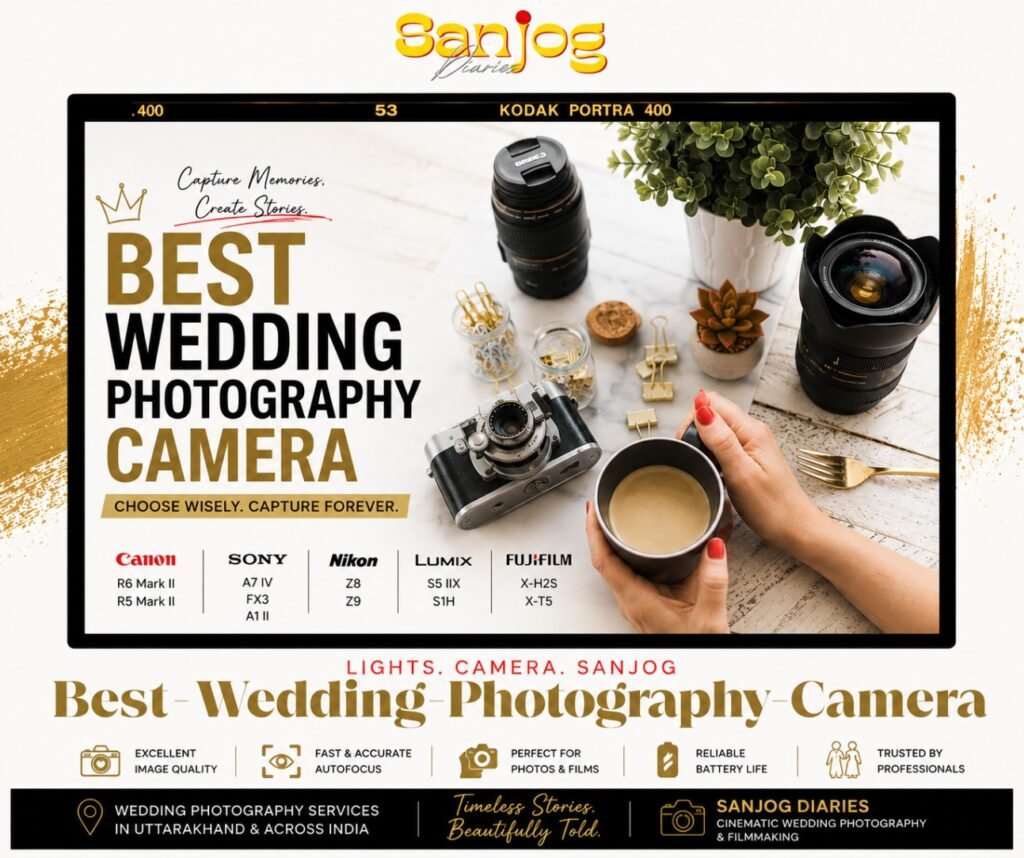
There’s a reason you’ll see so many Sony FX3, Sony A7 IV, Sony A7S III, and Sony A1 cameras at luxury weddings.
Sony simply understands video.
Their autofocus feels almost magical.
Imagine the bride walking toward the mandap.
Flower petals are falling.
Guests are standing.
Someone’s uncle walks directly in front of your lens with an iPad.
Yet somehow…
The camera still locks perfectly onto the bride’s eyes.
That’s the kind of confidence Sony gives you.
Low-light performance is another huge reason why wedding filmmakers love Sony.
Indian receptions rarely have perfect lighting.
Half the venue is glowing purple.
The DJ thinks every song deserves a laser show.
The smoke machine is working overtime.
Yet Sony cameras continue delivering clean, cinematic footage.
If your work revolves around cinematic wedding films and destination wedding photography in Uttarakhand, Sony is incredibly difficult to beat.
Canon: The King of Beautiful Skin Tones
Canon has a reputation that photographers have trusted for decades.
And honestly…
It deserves it.
Ask ten wedding photographers why they still shoot Canon.
Nine of them will probably say the same thing.
“The colors just look beautiful.”
Canon cameras produce warm, natural skin tones that often require very little editing.
That’s incredibly valuable during Indian weddings where every skin tone deserves to look rich and natural.
Models like the Canon R6 Mark II, Canon R5 II, and Canon R3 are outstanding choices for wedding photographers who shoot both photos and videos.
Canon autofocus has improved dramatically over the last few years.
Eye detection works beautifully.
Tracking is fast.
Reliability is excellent.
If photography is your primary business and filmmaking comes second, Canon remains one of the safest investments you can make.
Nikon: The Quiet Performer
Nikon doesn’t shout.
It simply delivers.
For years, people joked that Nikon wasn’t serious about video.
Then Nikon released cameras like the Z8 and Z9.
Suddenly everyone stopped laughing.
These cameras produce stunning image quality.
Excellent dynamic range.
Beautiful colors.
Reliable autofocus.
Outstanding still photography.
If you’re someone who primarily shoots photographs but also creates wedding films, Nikon offers an incredible balance.
It’s no longer just a photographer’s brand.
It’s a genuine hybrid system.
Panasonic Lumix: A Filmmaker’s Secret Weapon
Lumix cameras don’t always get the same hype as Sony or Canon.
But ask experienced filmmakers.
They’ll smile.
Panasonic focuses heavily on video features.
Waveforms.
Vectorscopes.
Internal codecs.
Open Gate recording.
Professional monitoring tools.
These are features filmmakers genuinely appreciate.
The Lumix S5 IIX has become one of the best value-for-money cameras for wedding filmmaking.
Its color science is fantastic.
Image stabilization is among the best in the business.
The only area where Sony still has an edge is autofocus.
If you’re comfortable pulling focus occasionally, Lumix rewards you with beautiful cinematic footage.
Fujifilm: The Artist’s Camera
Then there’s Fujifilm.
Fujifilm doesn’t try to be Sony.
Or Canon.
Or Nikon.
It has its own personality.
Its film simulations are famous for a reason.
Images feel nostalgic.
Timeless.
Almost as if someone sprinkled a little cinema magic straight out of the camera.
Many documentary wedding photographers love Fujifilm because the colors feel emotional before editing even begins.
If storytelling is your biggest priority and you enjoy a slightly different creative approach, Fujifilm is incredibly inspiring to shoot with.
Low Light Performance: Because Indian Weddings Love Darkness 🌙
Let’s be honest.
Indian wedding venues have a very strange relationship with lighting.
The stage is brighter than the sun.
The dance floor looks like a nightclub.
The bride’s makeup artist wants soft warm lighting.
The DJ wants flashing blue lasers.
The decorator adds fairy lights.
The priest lights the havan.
And somehow…
Everyone expects cinematic footage.
Welcome to wedding filmmaking.
This is where cameras stop being gadgets and start becoming lifesavers.
🥇 Sony
Sony still rules low-light performance.
Models like the Sony FX3, Sony A7S III, and Sony A1 II can comfortably shoot at higher ISOs while maintaining clean footage.
For reception parties, cocktail nights, and indoor weddings, Sony gives you confidence.
You spend less time worrying about noise and more time capturing emotions.
🥈 Canon
Canon isn’t far behind.
The Canon R6 Mark II is an absolute beast in low light.
Skin tones remain beautiful.
Noise is controlled.
Autofocus rarely misses.
If your work focuses more on photography than filmmaking, Canon performs brilliantly.
🥉 Nikon
The Nikon Z8 and Z9 also deliver impressive low-light results.
Their dynamic range is outstanding.
You can recover shadows beautifully during editing.
Lumix
Panasonic cameras perform surprisingly well.
Especially the Lumix S5 IIX.
Low-light quality is excellent.
The only slight drawback remains autofocus during very fast movements.
Fujifilm
Fujifilm performs well but APS-C models naturally can’t compete with full-frame cameras when light becomes extremely challenging.
That doesn’t mean they’re bad.
They simply play a different game.
Autofocus: The Feature That Saves Wedding Filmmakers Every Weekend
Let’s imagine something.
The bride starts walking toward the mandap.
Dad is emotional.
Mom is crying.
Flower petals are falling.
Guests suddenly stand up.
One enthusiastic uncle blocks your frame with his phone.
You cannot ask the bride to walk again.
This isn’t a movie.
It’s real life.
This is why autofocus matters.
Sony 👑
Sony’s Real-Time Eye AF feels almost unfair.
It locks onto faces.
Tracks movement.
Even if someone briefly blocks the subject, it quickly finds the face again.
For documentary-style weddings, Sony is simply outstanding.
Canon ❤️
Canon’s Dual Pixel Autofocus deserves every bit of praise it receives.
It’s smooth.
Reliable.
Natural.
Photographers especially love how confidently Canon tracks eyes during portraits.
Nikon 📸
Nikon has improved dramatically.
Its latest cameras compete surprisingly well.
If you haven’t used Nikon in the last few years…
You’re in for a pleasant surprise.
Lumix 🎥
Panasonic has improved autofocus massively.
Older Lumix cameras struggled.
The latest generation finally feels dependable enough for professional weddings.
Fujifilm 🎞️
Fujifilm autofocus has also improved significantly.
Still, Sony and Canon continue to hold a slight advantage for unpredictable wedding moments.
Battery Life: Because Weddings Never End on Time 😂
If an invitation says:
“Dinner starts at 8 PM.”
You already know what that means.
Dinner starts around…
10:15 PM.
Indian weddings follow their own time zone.
Which means your camera needs stamina.
Sony cameras offer excellent battery life.
Canon has improved significantly.
Nikon is equally dependable.
Lumix surprises many filmmakers with its endurance.
Fujifilm performs well but generally requires carrying an extra battery or two for full wedding coverage.
Pro tip:
No matter which brand you buy…
Always carry extra batteries.
Murphy’s Law loves weddings.
Lens Ecosystem Matters More Than Camera Bodies
Most beginners spend weeks comparing camera bodies.
Hardly anyone talks about lenses.
That’s a mistake.
A great lens will stay with you for years.
Camera bodies change every three or four years.
Sony currently has the biggest third-party lens ecosystem.
Sigma.
Tamron.
Samyang.
Viltrox.
Everyone makes Sony lenses.
That means more choices.
Better prices.
More flexibility.
Canon has fantastic RF lenses but third-party options are still catching up.
Nikon’s Z lenses are phenomenal.
Lumix and Fujifilm also offer excellent native glass, though the selection is smaller compared to Sony.
Which Camera Do We Use at Sanjog Diaries?
People ask us this all the time.
“Which camera does Sanjog Diaries use?”
The answer is simple.
We choose equipment based on the story we’re telling.
A wedding in Triyuginarayan Temple demands different preparation than a luxury ballroom reception in Dehradun.
A mountain wedding in Mussoorie has different lighting than a riverside ceremony in Rishikesh.
That’s why we invest in reliable professional equipment that performs consistently in every situation.
Because our clients don’t hire us for a camera.
They hire us for memories.
So… Which Camera Should You Buy?
Buy Sony if…
✅ You create cinematic wedding films.
✅ Video is your priority.
✅ You love incredible autofocus.
✅ You frequently shoot destination weddings.
Buy Canon if…
✅ Photography comes first.
✅ You love natural colors.
✅ Portraits are your specialty.
Buy Nikon if…
✅ You want one camera that excels at both photos and videos.
✅ Dynamic range matters.
Buy Lumix if…
✅ You’re a filmmaker first.
✅ You want professional video features without spending a fortune.
Buy Fujifilm if…
✅ You love storytelling.
✅ You want artistic colors.
✅ Documentary photography excites you.
Final Thoughts
After years of shooting weddings across Uttarakhand, we’ve realized something important.
The best wedding photographer isn’t carrying the most expensive camera.
They’re the one who notices the bride smiling at her grandmother.
The groom quietly taking a deep breath before the varmala.
The father trying not to cry.
Those are the moments couples remember forever.
At Sanjog Diaries, our mission has never been about owning the latest gear. It’s about creating cinematic wedding films and timeless photographs that preserve emotions exactly as they happened.
Whether you’re looking for Wedding Photography Services in Uttarakhand, a Wedding Photographer in Dehradun, a Destination Wedding Photographer in Mussoorie, or a team to document your wedding in Rishikesh or Triyuginarayan Temple, we’d love to tell your story.
Because cameras capture light.
Stories capture hearts. ❤️